

The dining room is where Christmas actually happens. The tree gets the photos, the living room gets the lounging — but the dining table is where everyone sits down together, where the food lands, where the long conversations stretch past dessert. And yet it is the room most people decorate last, usually the afternoon guests arrive, with a tablecloth thrown over whatever was already there.
It does not need much. A dining room at Christmas works when the table is dressed, the light is low and warm, and there is one clear focal point you can see over while you eat. Everything else — the sideboard, the window, the corner tree — is supporting cast.
Below are 24 specific ways to make it happen, from a 10-minute table runner swap to a garland centerpiece, a drinks station on the sideboard, and a pack-away plan so January takes an hour, not a weekend.
Start with one Christmas color story for the whole dining room

A dining room goes wrong fastest at the buying stage: a red runner one year, gold chargers the next, green napkins on sale — and by December nothing matches. The table is viewed all at once, from every seat, so a scattered palette reads as clutter, not abundance.
Pick two colors plus one metal, then style only inside that. Three combinations that work especially well: deep burgundy and pine green with antique gold for a rich, formal feast; warm ivory and soft brown with brushed brass for a calm, farmhouse room; or cranberry, warm white and pewter for classic Christmas dialled down. Keep roughly 70 percent neutral base, 20 percent your main holiday color, and 10 percent the accent. Use the same story on the table, the sideboard and the window, so the room reads as one decision instead of three shopping trips.
Lay a garland down the center of the table
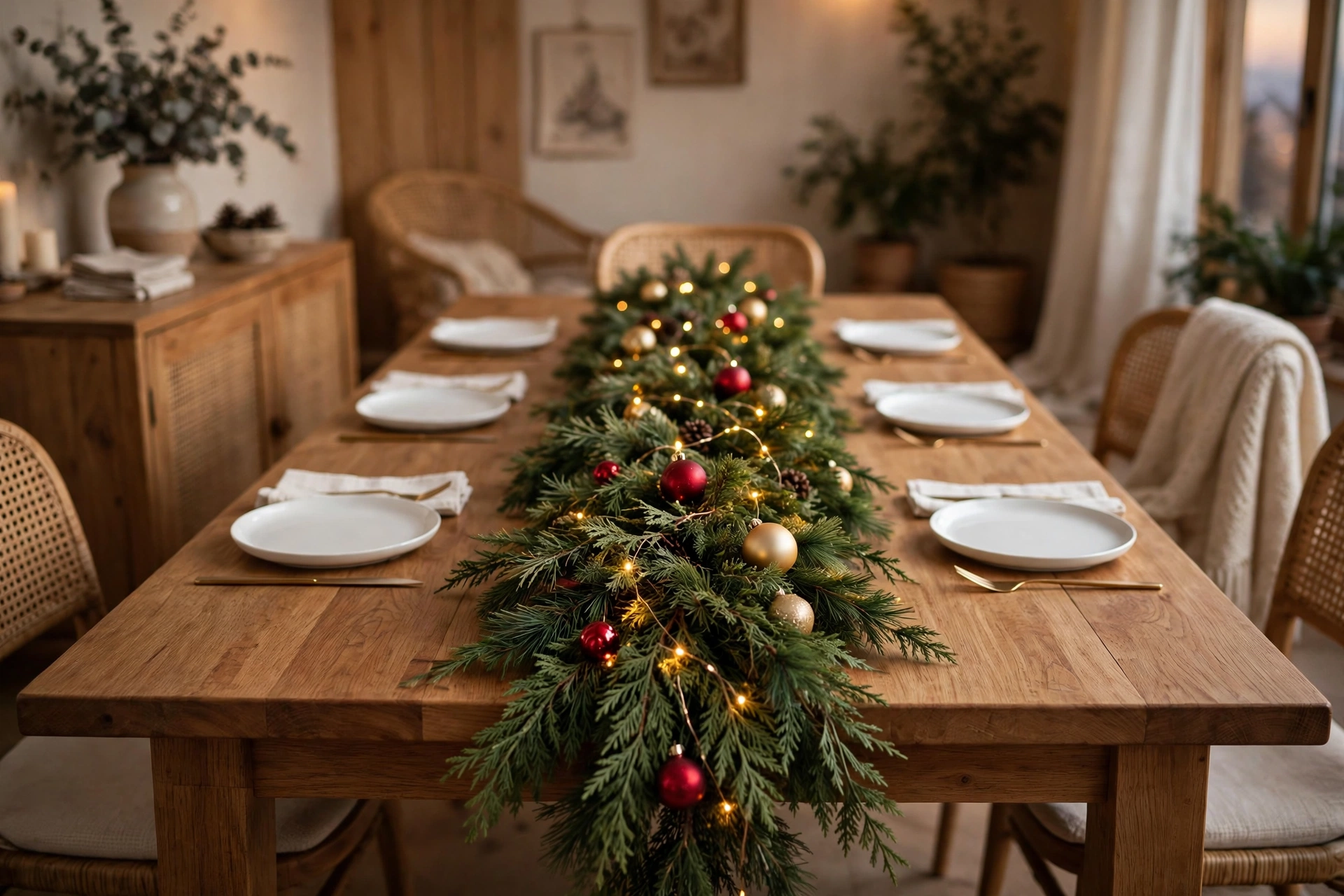
A table garland is the fastest way to make a dining table look dressed, and it costs less than a full centerpiece. The mistake is buying one that is too short, so it stops awkwardly in the middle, or too tall, so it blocks the person across from you.
Choose a garland 6 to 9 feet long for a standard 6-seat table, so it drapes 6 to 12 inches over each end, and keep it no more than 4 to 6 inches wide at its fullest point. Lay it straight down the center, then tuck in pinecones, a few ornaments in your color story, and a strand of warm micro lights before you add plates. Faux cedar or pine is the right call here — real greenery sheds needles into the food and dries out under candle heat. If your table seats eight or more, join two garlands with floral wire in the middle and hide the join under a candle cluster.
Build a low centerpiece you can actually see over

The classic dining room error is a centerpiece built for a photograph, not a meal: tall, wide, and right where eye contact should be. Nobody wants to lean around a vase to talk to their own family.
Keep the whole centerpiece under 12 inches tall, including candles, and under 18 inches wide at its base, so sightlines stay open across the table. A good formula is a low wooden tray or dough bowl, 18 to 24 inches long, holding three pillar candles in different heights, a handful of greenery, and two or three ornaments. Set it in the middle of the garland, not beside it, so the table reads as one long arrangement. For a round table, use a single low bowl or a lazy Susan dressed the same way, about 14 inches across.
Dress the chandelier or pendant with greenery

Guests always comment on a dressed chandelier, because it is the one decoration at eye level when you walk in — and it costs almost nothing if you already own a garland. It is also the decoration most likely to be done badly, with greenery hanging so low it catches hair or drips wax.
Weave a thin 6-foot garland loosely around the chandelier arms or pendant cord, or hang three to five ornaments from it on ribbon at staggered lengths, 8 to 14 inches long. Keep every hanging piece at least 18 inches above the tabletop and well clear of any candle flame or hot bulb. Battery micro lights woven through the garland are safer than anything wired, and they make the whole fixture glow from above, which is exactly the light a Christmas dinner wants.
Choose a runner that fits the table, not the room
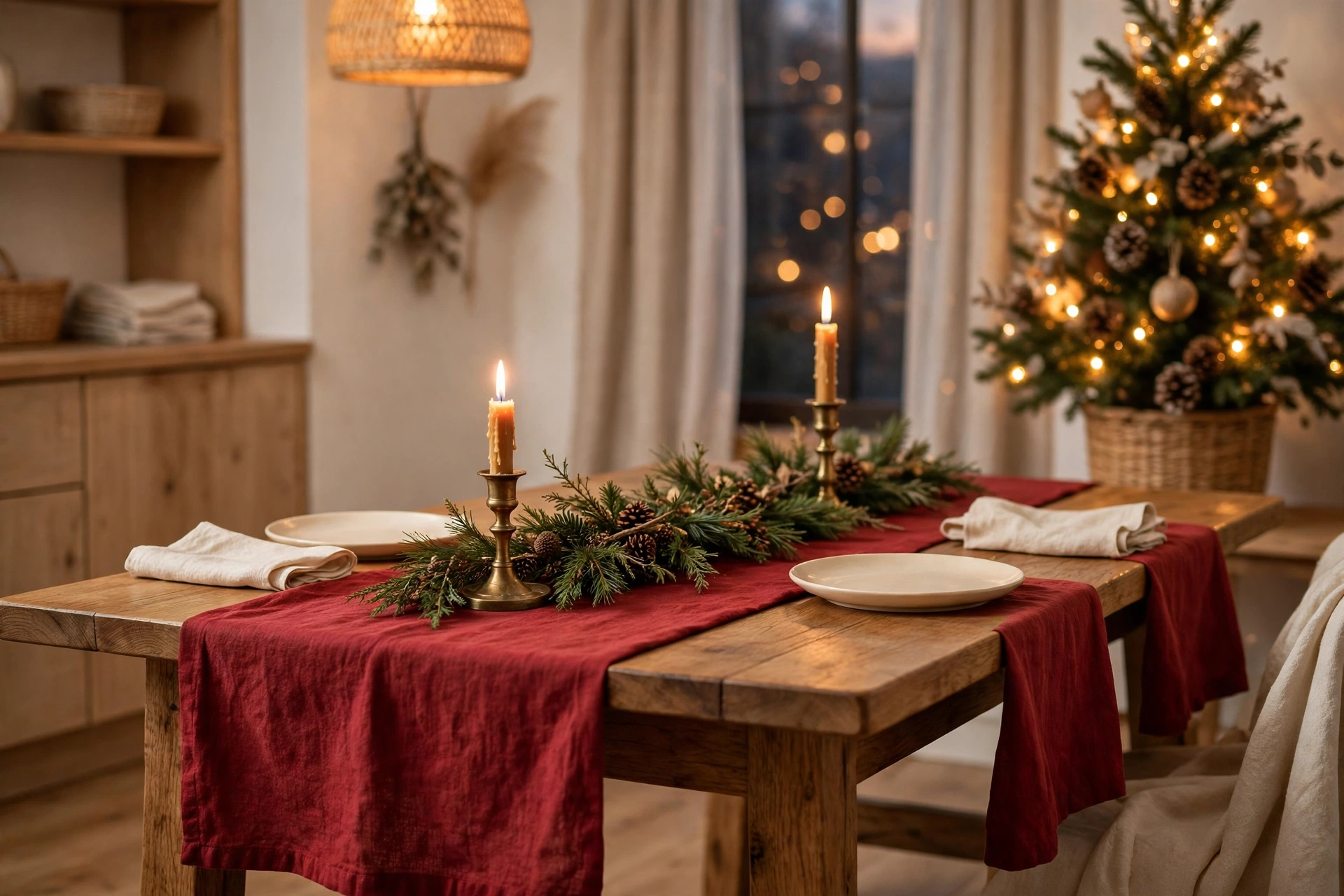
A runner that is too short makes the table look unfinished; one that pools on the floor gets pulled every time someone stands up. Get the size right once and the rest of the table styling gets easier.
Measure the table length and add 12 to 24 inches total, so the runner hangs 6 to 12 inches over each end, and choose a width about one-third of the table’s width — roughly 12 to 14 inches on a 36 to 42 inch wide table. A linen or cotton runner in your main holiday color, or a plaid in your color story, is enough; the garland and centerpiece do the pattern work on top. If you eat at this table every day, keep a washable runner on through December and swap it for the good one only on feast days.
Mix taper candles in three heights
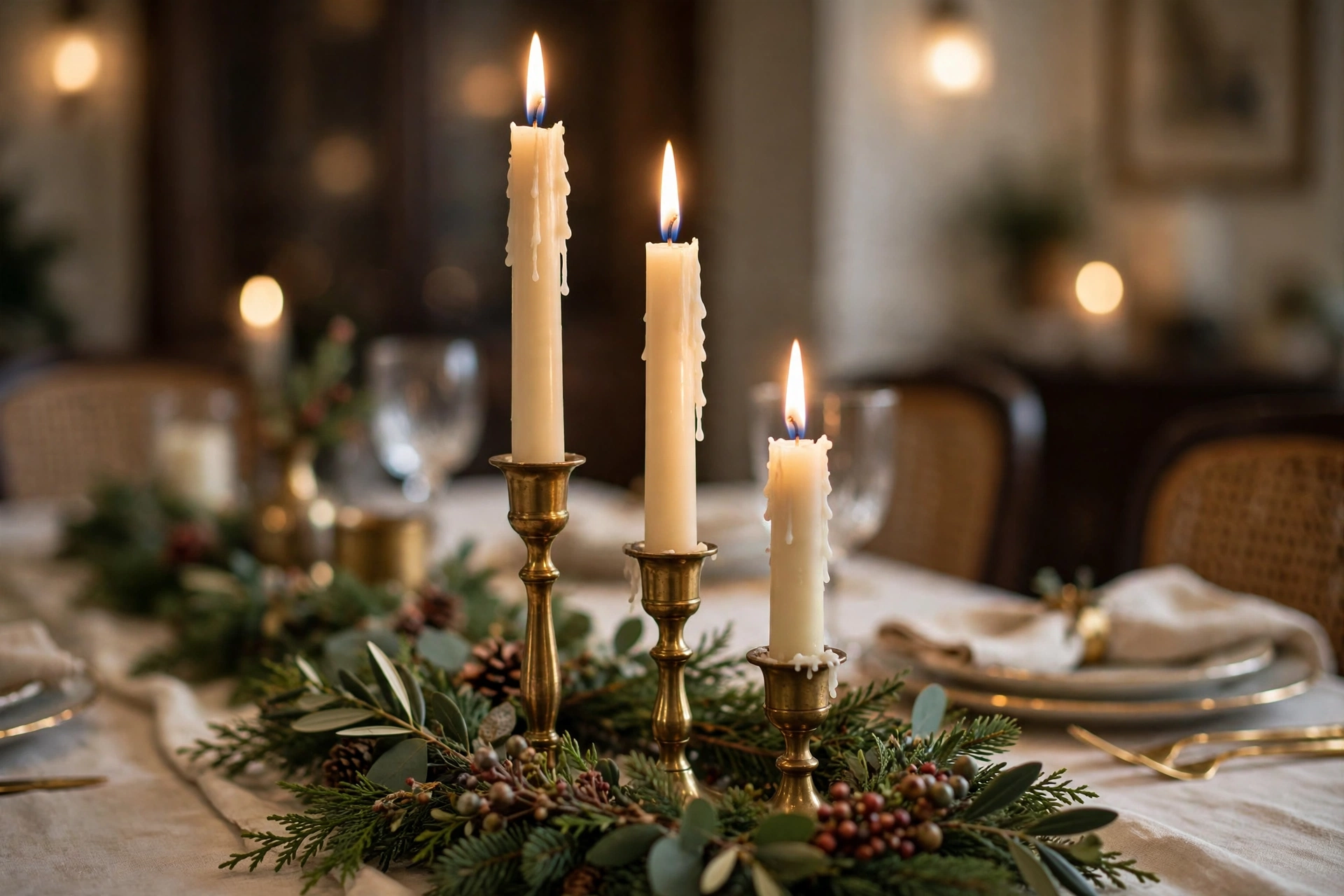
Candlelight is what turns a decorated table into a Christmas table. A single height of candles looks like a shop display; three heights look like a home. The trick is keeping flames low enough to see over and far enough from the garland to be safe.
Use taper candles in 6, 8 and 10 inch heights, in brass or matte black holders, grouped in clusters of three along the garland — one cluster per two place settings is about right. Keep every flame at least 12 inches from any greenery, paper or fabric, and at least 6 inches from the nearest plate. Battery taper candles with a flicker setting are a sensible swap if children sit at the table, or if the table is narrow; from two feet away, nobody can tell.
Layer the plates like a proper place setting
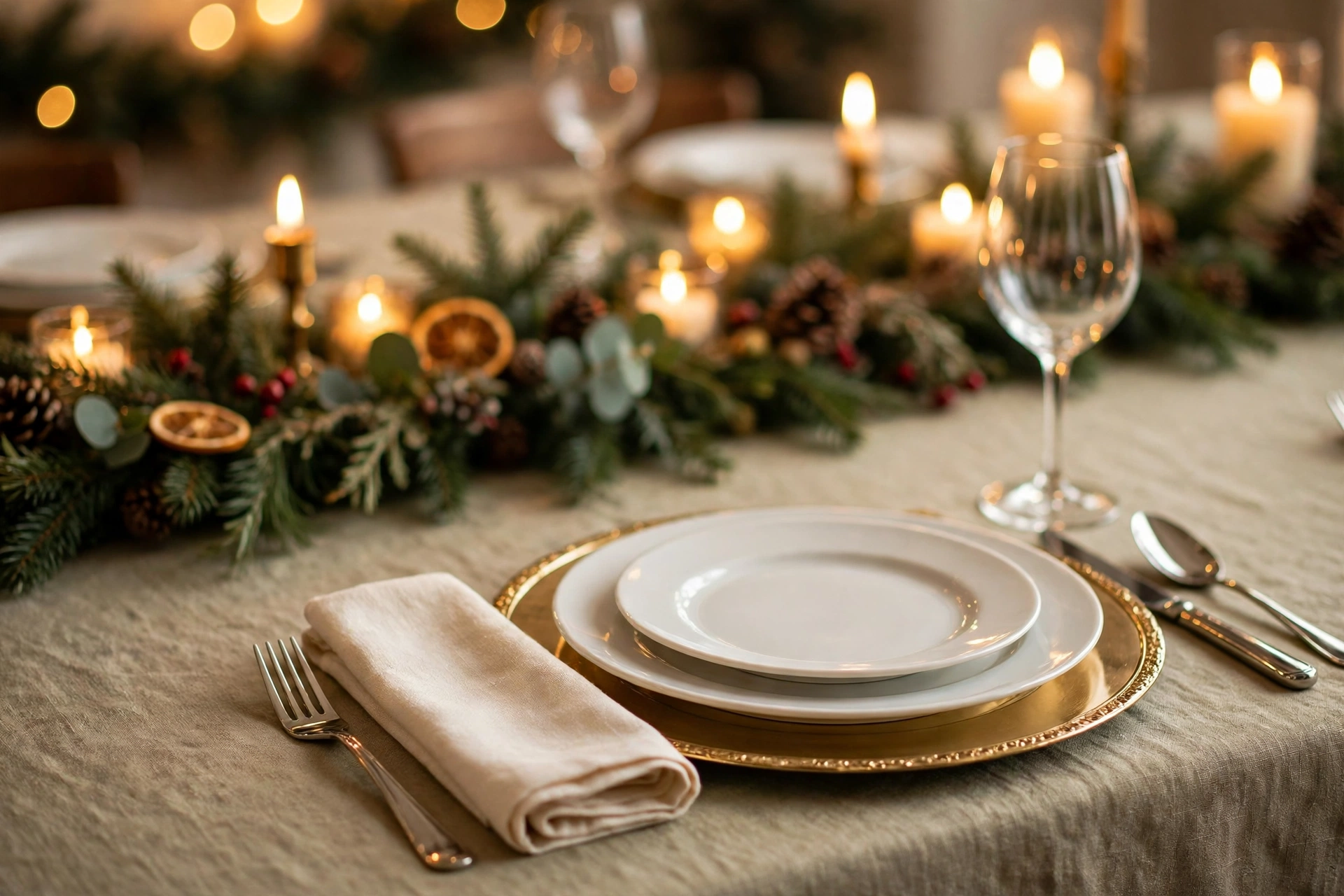
Layered plates are the cheapest luxury in this whole list: a charger under a dinner plate under a salad plate turns an ordinary meal into an occasion, and you probably own two of the three layers already.
Start with a charger, 12 to 13 inches across, in gold, brass or woven rattan. Add the dinner plate, 10 to 11 inches, then a salad or dessert plate, 7 to 8 inches, on top. Leave about 1 inch of table showing between each place setting and the next, and about 24 inches of table width per person so elbows and glasses do not collide. If you do not own chargers, a large woven placemat, 15 inches across, does the same job and costs far less than a new set of plates.
Fold each napkin with a sprig of greenery

A napkin with a sprig tucked in it is a five-minute touch that makes every guest feel considered, and it is the detail people photograph. The mistake is overcomplicating the fold — a complicated fold that collapses before dinner is worse than a simple one.
Fold a cloth napkin into a simple rectangle or a loose pocket, lay it on the plate or to the left of the fork, and tuck a 4 to 6 inch sprig of pine, eucalyptus or rosemary into the fold, with a small pinecone or a cinnamon stick tied on with twine if you like. Use the same sprig on every setting so the table reads as a set. Cloth napkins in warm white or your main holiday color wash and reuse all December; paper napkins in the same treatment are fine for a big family gathering, just choose thick ones that hold the fold.
Put a small tree in the dining room corner
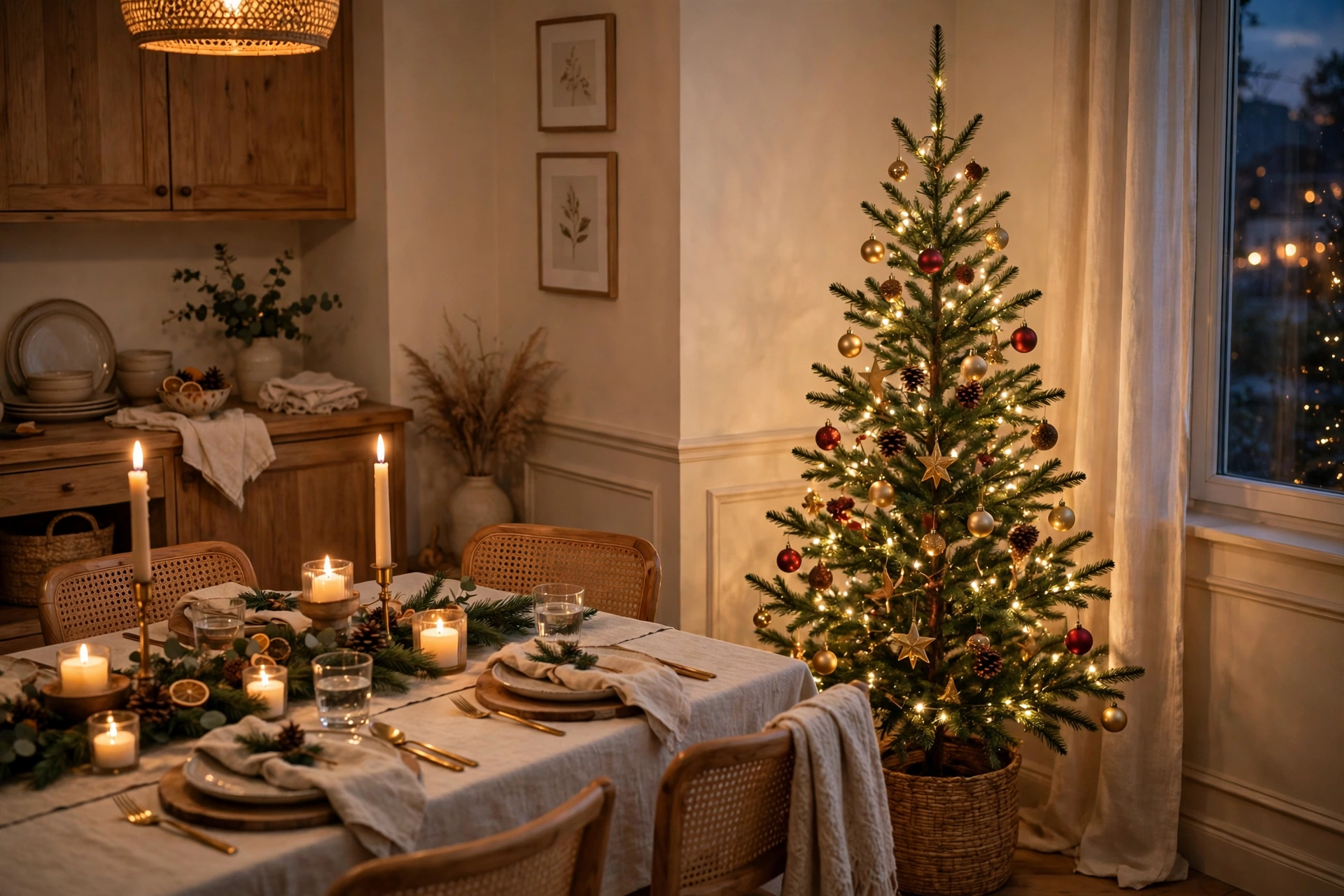
A dining room does not need a second full tree — but a small one in the corner makes the room feel finished, especially in the evening when its lights are the only glow in the room. A floor tree squeezed behind chairs just gets in the way.
Choose a slim tree 4 to 5 feet tall for a corner, or a 2 to 3 foot tabletop tree on a sideboard or plant stand, and keep its widest point at least 12 inches from the nearest chair so nobody brushes it standing up. Decorate it in just your room’s palette, with ornaments in two sizes, and warm white lights. If the dining room is also the route to the kitchen, a corner tree on a sturdy stand is safer than one on the floor — no trailing cord across a walkway.
Style the sideboard as a drinks and dessert station
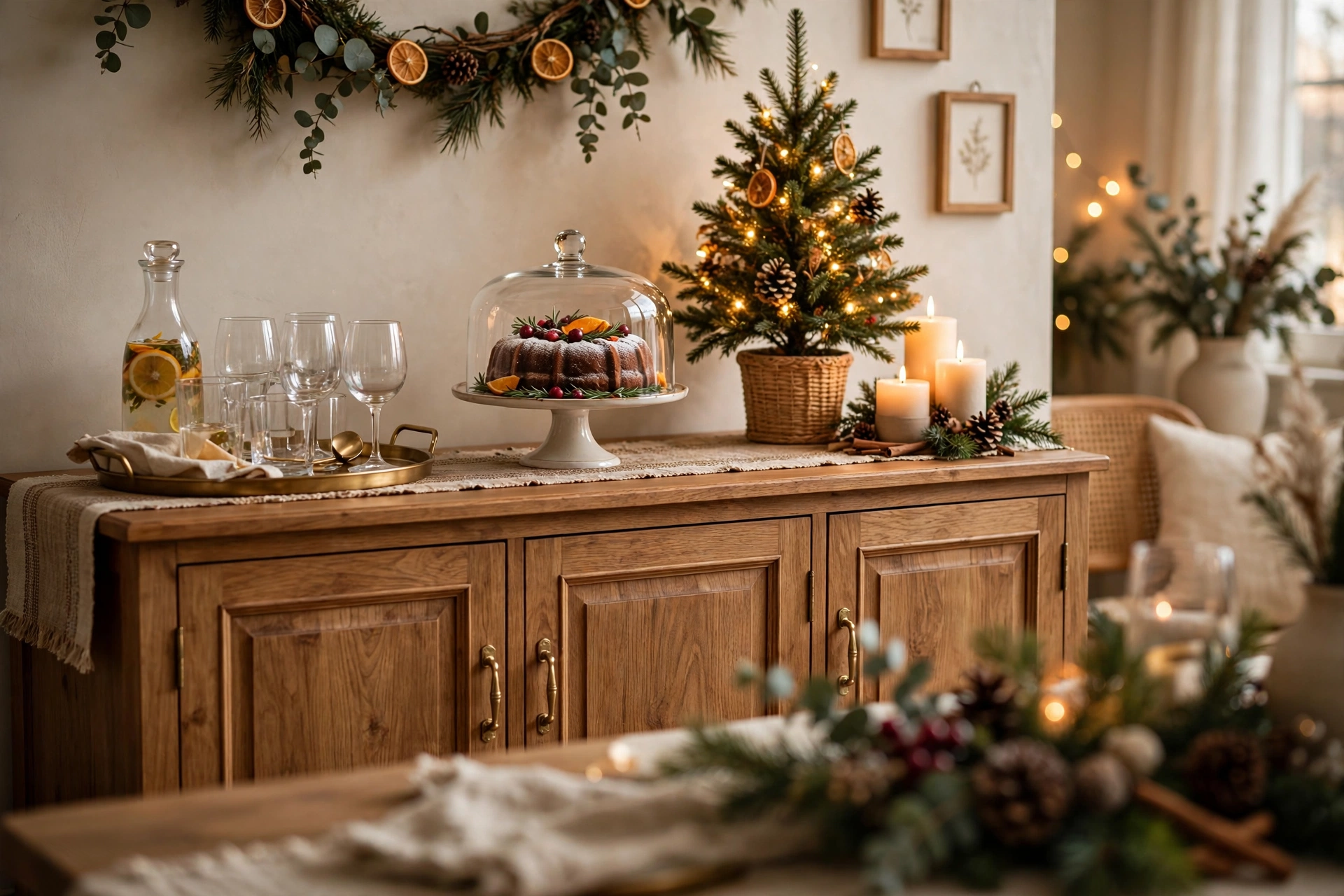
A sideboard is the dining room’s secret weapon: it takes the clutter off the table and gives guests somewhere to help themselves. Left bare, it is just a piece of furniture; dressed as a station, it is the most useful decoration in the room.
Clear the sideboard completely, then set it in three zones: drinks on one end (glasses, a carafe or punch bowl, and a small tray for bottles), desserts or the cheese board in the middle, and a small festive touch on the other end (a mini tree, a candle cluster, or a stack of extra plates). Leave at least 12 inches of clear counter in front of each zone so people can set a glass down. A runner down the sideboard, 12 inches wide, ties it to the table without matching it exactly.
Hang a wreath where guests actually see it
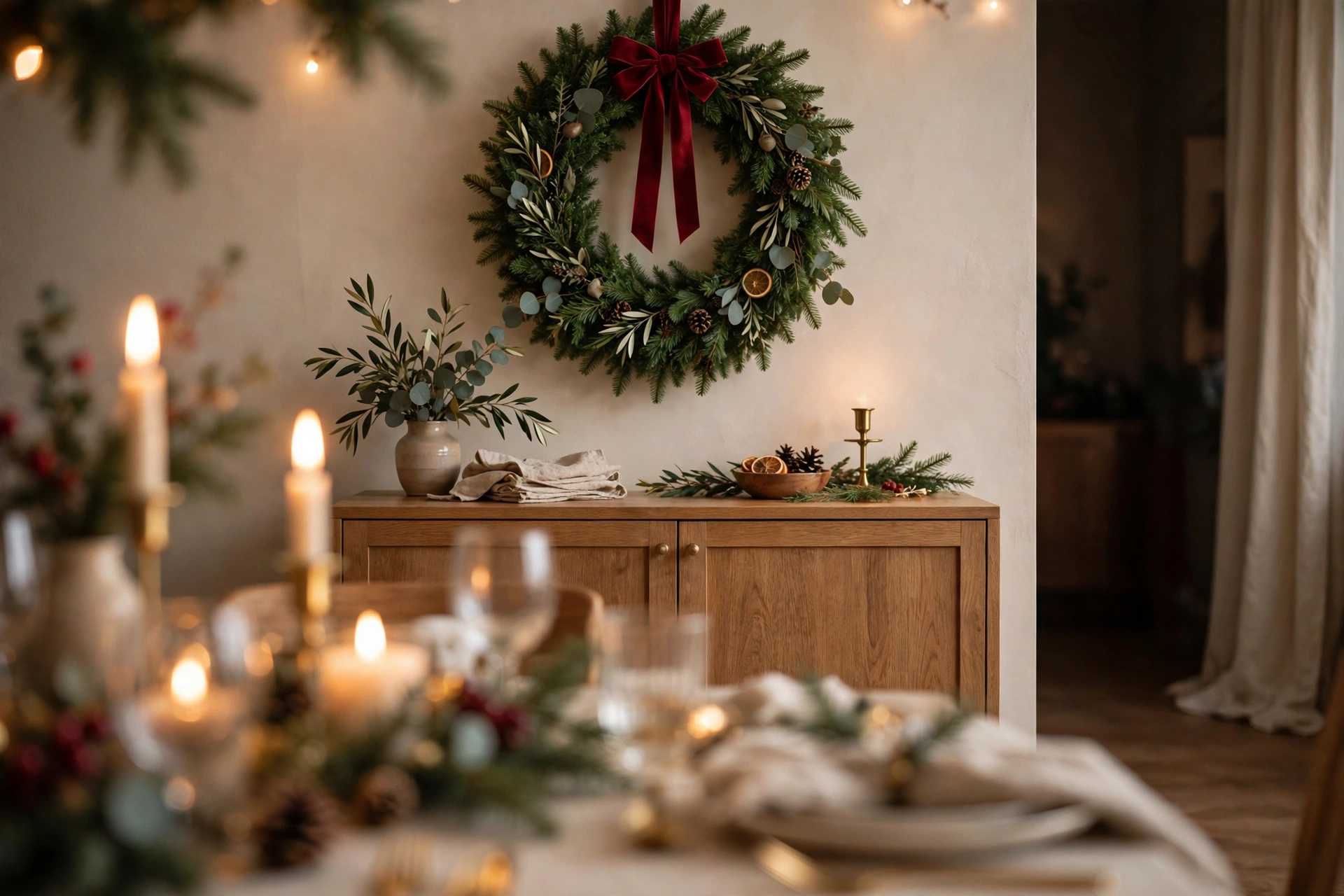
A wreath in the dining room works best where it frames the meal: on the wall behind the sideboard, on the dining room door, or in the window behind the table. Hung where nobody looks, it is just another decoration.
Hang a 20 to 24 inch wreath so its center sits about 60 inches from the floor on a wall, or centered in a window with a suction hook rated for its weight. Add one accent only — a velvet ribbon with tails no longer than 10 inches, or a small cluster of pinecones at the base. In a rental, a single adhesive hook or a ribbon looped over a picture hook holds it with no new holes. Match the wreath greenery to the table garland so the two read as a pair.
Keep chair decor simple enough to sit on

Chair bows photograph beautifully and annoy everyone who actually sits down. The rule for dining chairs is simple: if it touches the sitter, it does not belong there.
Skip full chair covers and big bows. If you want the chairs dressed, tie a single small sprig of greenery or a short ribbon to the top rail of each chair, on the back side, where it is visible from across the room and never in anyone’s way. Keep it under 6 inches long and fastened with twine, not tape. For a special dinner, a thin velvet ribbon in your color story, tied in a small bow at the top of each chair back, is enough — and it takes five minutes for a whole table.
Dim the overhead light and let candles do the work
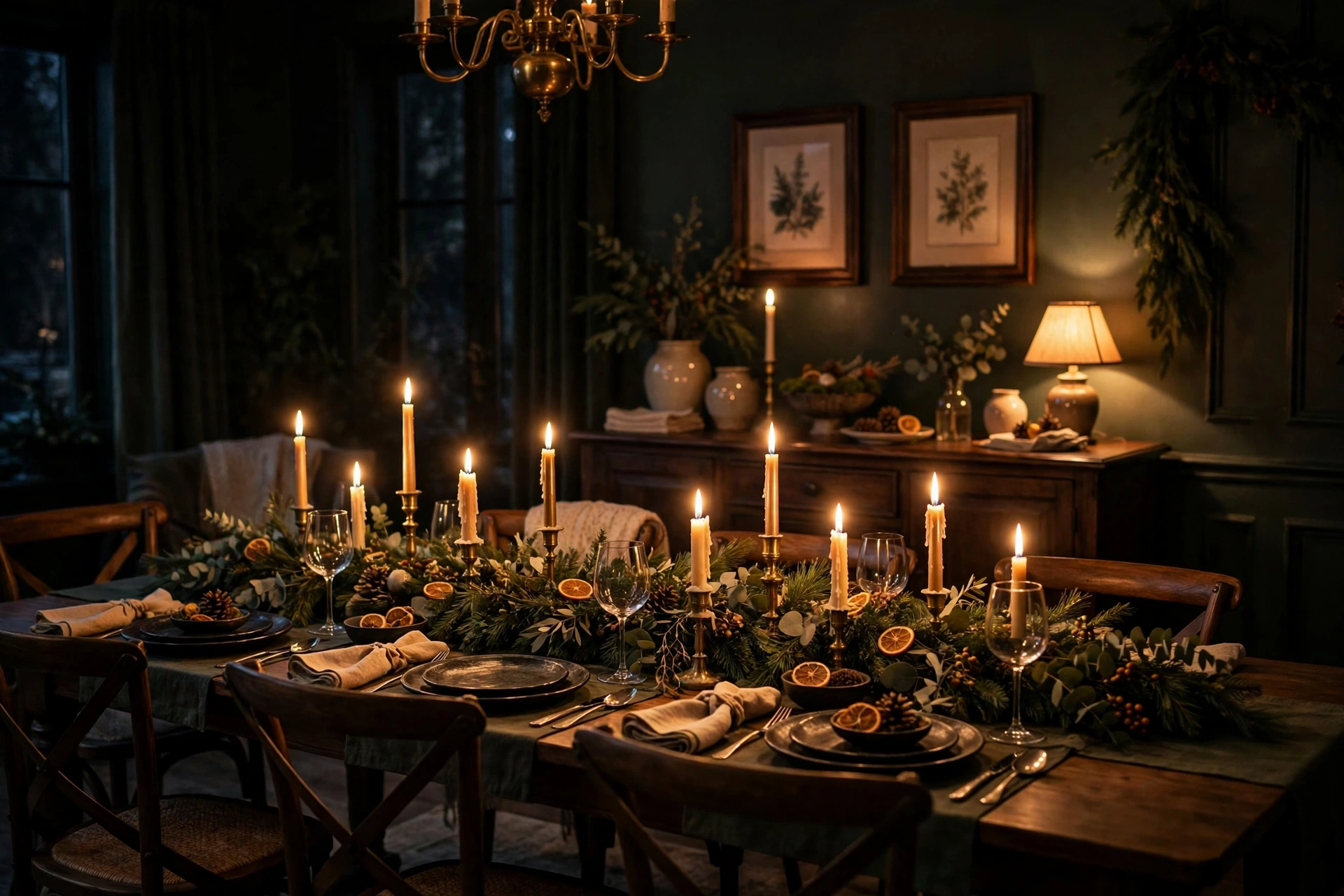
Nothing kills a Christmas dinner faster than a bright ceiling light. Dining rooms at Christmas should be lit the way winter feels best: low, warm, and close to the table.
Turn the overhead down to its lowest dimmer setting, or off entirely, and work with three low sources instead: the chandelier or pendant on dim, the taper candles on the table, and one small lamp or candle group on the sideboard. Use warm bulbs around 2700K everywhere, and a 10 to 16 foot warm-white fairy strand woven through the garland if you want extra glow. Battery candles on a timer, switching off at midnight, are both safer and kinder to the electric bill than lights left on all night.
Add a washable rug under the table
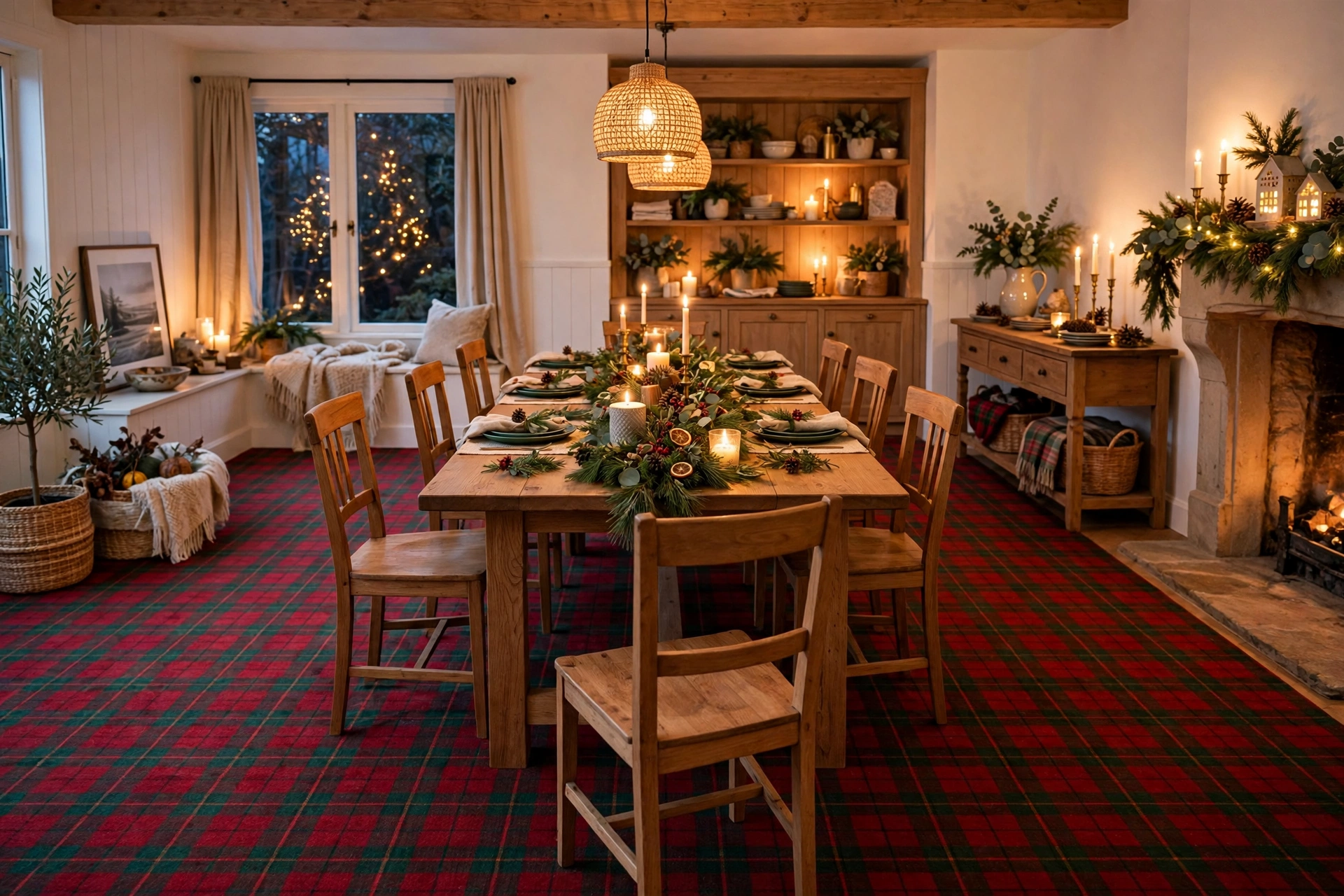
A rug under a dining table makes the whole room feel warmer and quieter, and at Christmas it grounds all the greenery and candlelight. The fear is always the same: red wine, gravy, and a rug that can never be cleaned.
Choose a flat-weave or low-pile rug, machine-washable if you can find one, in a deep red, green or neutral plaid that hides crumbs. Size it so it extends at least 24 inches beyond the table on every side — for a 6-foot table, that means roughly 8 by 10 feet — so chairs stay on the rug when they are pulled out. A rug pad underneath stops it sliding on hard floors, and a quick vacuum after dinner is enough until the proper wash in January.
Create a hot cocoa or mulled wine station
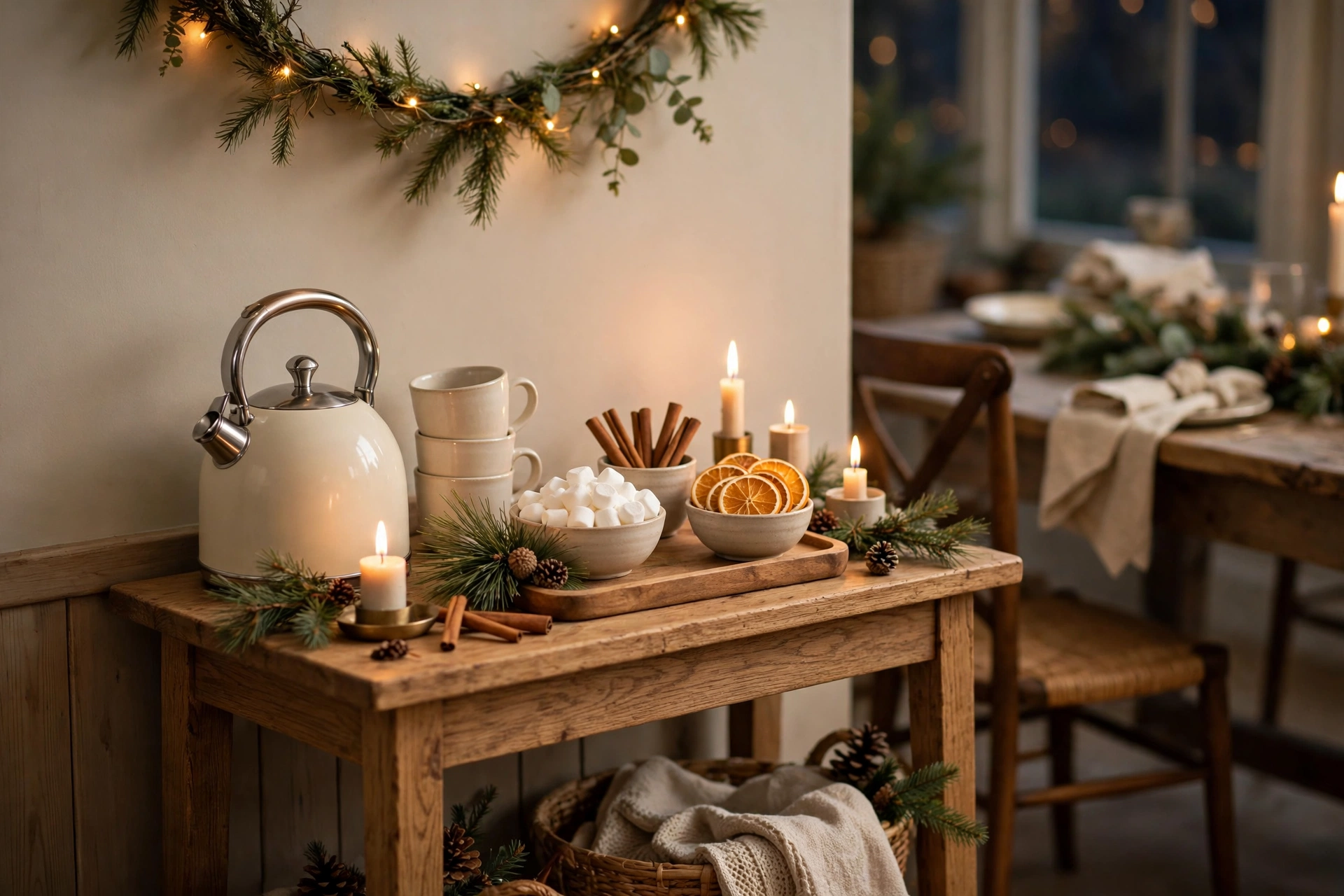
A drinks station is the dining room idea guests remember, because it gives them something to do with their hands while dinner finishes. It also keeps the kitchen clear of people looking for a refill.
Set it on the sideboard or a small console: a slow cooker or kettle for mulled wine or cocoa, mugs hung from small hooks or stacked two high, and toppings in small bowls — marshmallows, cinnamon sticks, star anise, orange slices. Label each topping with a small handwritten card. Keep the station at least 24 inches from the table edge so the queue does not block the chairs, and put a small tray under everything to catch drips. For families with children, a cocoa station with the same setup is the version everyone can use.
Use natural elements you already have

The most expensive-looking Christmas dining rooms are often the cheapest to make, because they use what is already around the house: pinecones from the garden, oranges from the fruit bowl, cinnamon from the spice drawer.
Scatter pinecones along the garland, one every 12 inches or so, and fill a low bowl with dried orange slices, cinnamon sticks and a few sprigs of rosemary for a centerpiece that smells like Christmas without a single plug. A halved orange studded with cloves, set on each place setting or on the sideboard, is a classic that costs almost nothing. Keep natural elements away from candle flames and out of the food itself, and replace fresh fruit every three to four days so it never looks tired.
Dress the windows with garland and lights
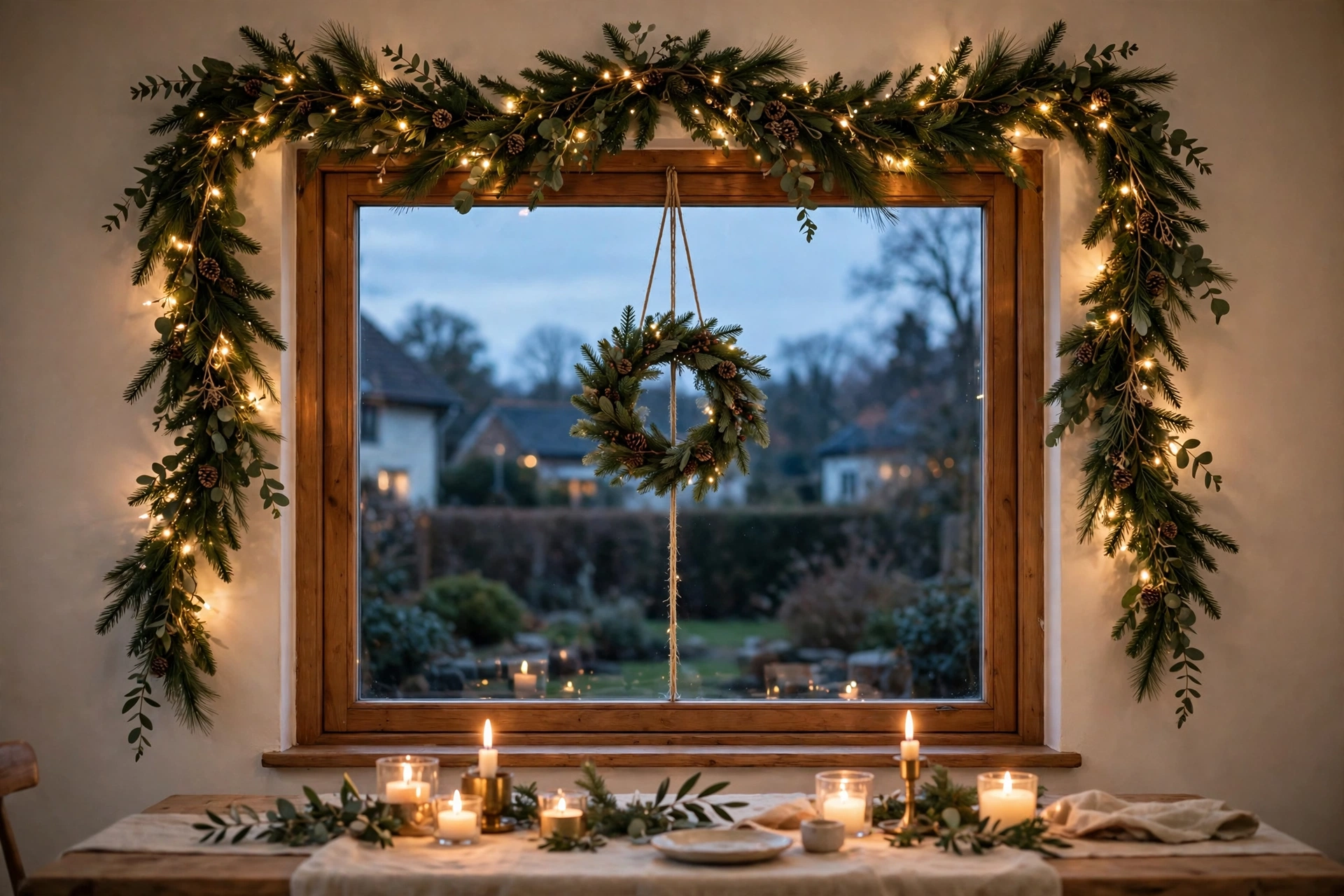
Dining room windows are usually bare, which is a waste in December: from outside, a lit window is the whole house’s Christmas card, and from inside it frames the table in greenery.
Run a garland along the top of the window frame, letting it dip 8 to 10 inches at each end, and weave a warm-white fairy strand through it before you hang it. Add a wreath in the center of the window, hung from a suction hook, or a row of three small ornaments on ribbon at different lengths. Keep cords behind the curtain or along the frame, never across the walkway, and use battery lights where there is no outlet nearby so the window can glow without a trailing cable.
Give the kids their own place settings

Children at a Christmas table are happiest when the table treats them like guests, not afterthoughts. A small version of the adult setting — not a plastic one — makes them sit taller and spill less.
Set each child’s place with the same charger and plate, a smaller glass they can actually lift, and one fun touch: a paper crown, a small ornament to take home, or a place card with their name in your handwriting. Keep the centerpiece low and the candles out of their reach — put the candle clusters at the adults’ end of the table, or swap to battery candles for the whole table if the youngest guests are under five. A washable tablecloth under the runner, just for the kids’ end, saves the good linen.
Write place cards by hand

Place cards are the smallest decoration on the table and the one guests keep. They also solve the real problem of a Christmas table: twelve people standing around wondering where to sit.
Write each name on a small folded card, about 2 by 3 inches, in your best handwriting, and prop it against the plate or tuck it into the napkin fold. Use the same card stock and ink for every guest so the table reads as a set. A sprig of rosemary or a tiny pinecone glued to the card is enough decoration. If you are seating people strategically — keeping the talkers apart, the kids near a parent — place cards do that work politely, without a single awkward conversation.
Add metallics in one place only

Metallics are what make a Christmas table feel festive rather than just green, but spread across every surface they turn the room into a gift shop. Choose one place for the shine and keep the rest matte.
Gold chargers are the easiest choice — they catch the candlelight from every seat — or brass candlesticks if you already own them. Use one metal only: gold with warm wood and burgundy, silver or pewter with cool greens and white. Keep the metallic to the table itself, and let the sideboard, windows and tree stay in wood, greenery and fabric. One shiny layer is a highlight; three is a theme park.
Add one plaid layer, and only one
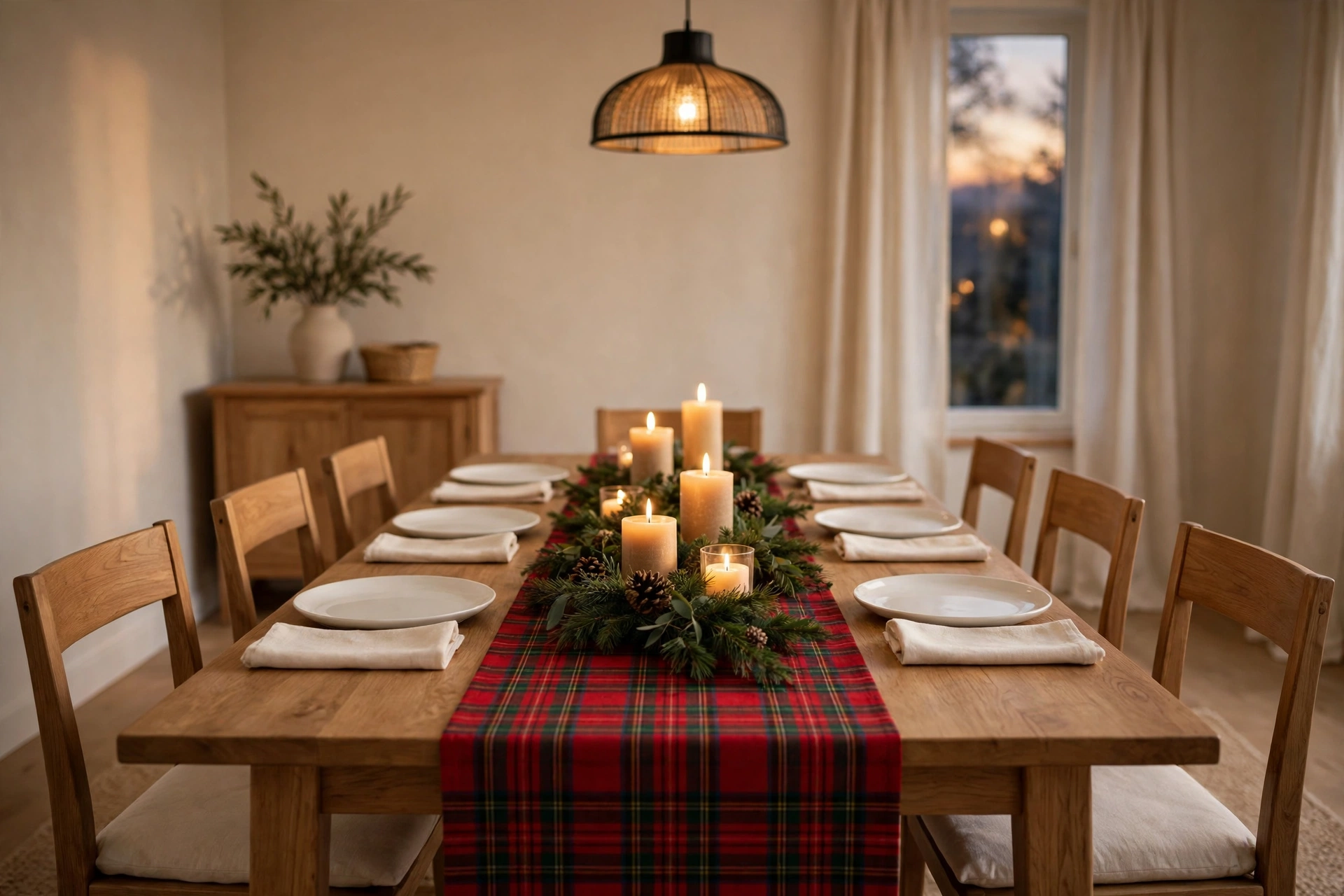
Plaid is the fastest shortcut to Christmas, and the easiest to overdo. One plaid layer — the runner, or the napkins, or a throw over a side chair — is a statement. Two plaids fighting each other is a mess.
Pick the runner as your plaid piece if the table is the focus, in a tartan that uses your two colors, and keep the napkins solid. Or keep the runner solid linen and use plaid napkins, one per setting, folded simply so the pattern reads. The plaid should be the only strong pattern in the room: if the rug is patterned, the runner is solid, and vice versa. A 12 to 14 inch wide plaid runner on a 6-foot table is enough pattern for the whole meal.
Style a bar cart for Christmas
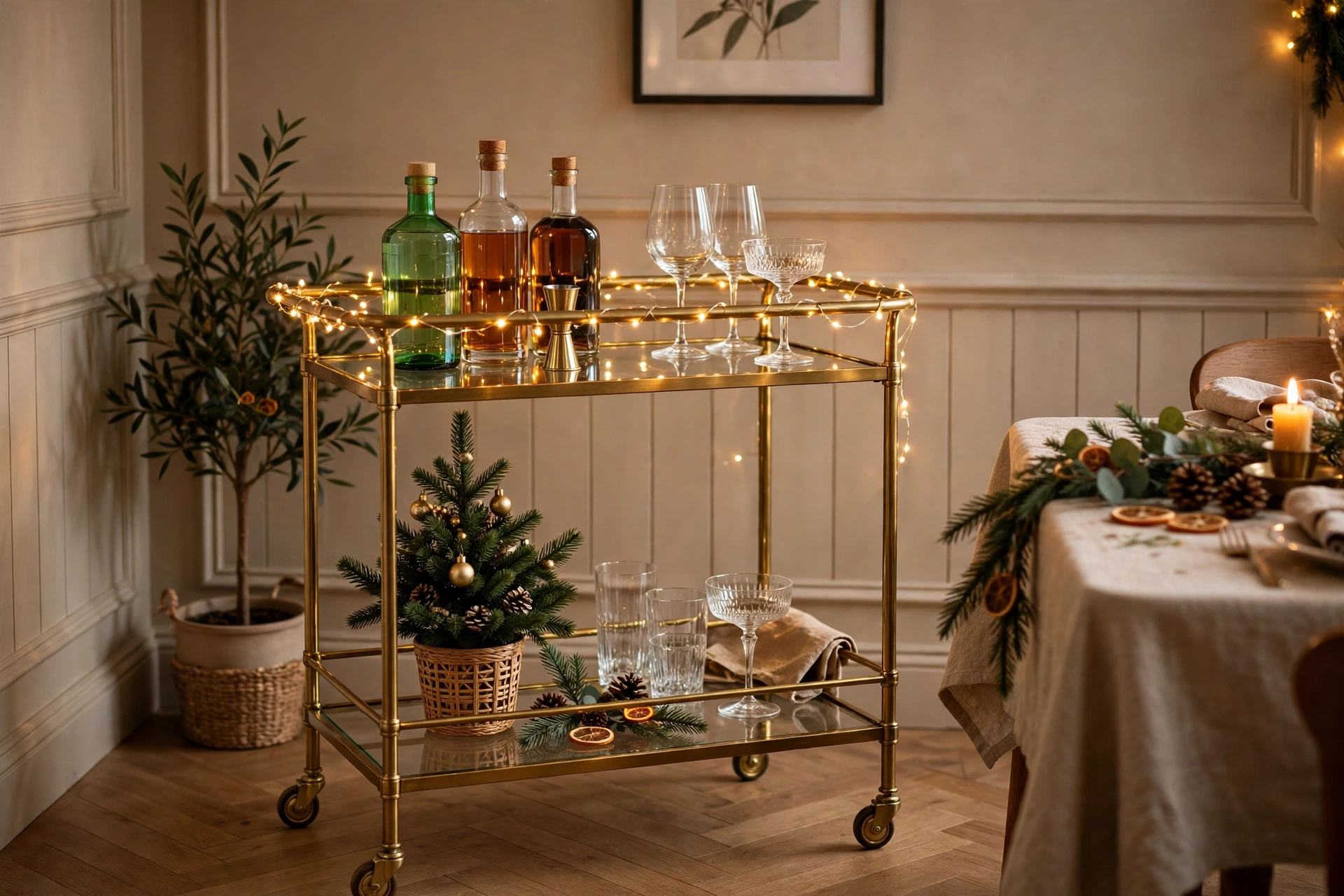
If you own a bar cart, Christmas is its moment. Dressed, it is a drinks station, a decoration and a conversation piece in one — and it rolls out of the way when dinner is served.
Clear the cart to three things per shelf: bottles and glasses on top, a small garland or a mini tree in the middle, and extra glasses or napkins below. Add a string of battery fairy lights around the top rail and a small framed winter print propped against the back. Keep the cart at least 36 inches from the table so the aisle stays clear, and park it against the wall during the meal so nobody has to squeeze past it with a hot plate.
Keep a swap system for everyday meals

The reason most Christmas dining rooms look tired by mid-December is that the table is dressed for a feast and then has to survive three weeks of ordinary breakfasts. Build the decoration in two layers: a permanent one and a feast one.
Keep the runner, the garland and the sideboard dressing up all December — that is the everyday layer, and it takes no work to maintain. The feast layer is the chargers, the layered plates, the taper candles and the place cards, which live in a single labelled box on the sideboard and come out only for dinners. Setting the feast layer takes about 15 minutes once the box is packed, and clearing it takes five. The table never has to be undressed and redressed from scratch.
Plan the pack-away before you put anything up
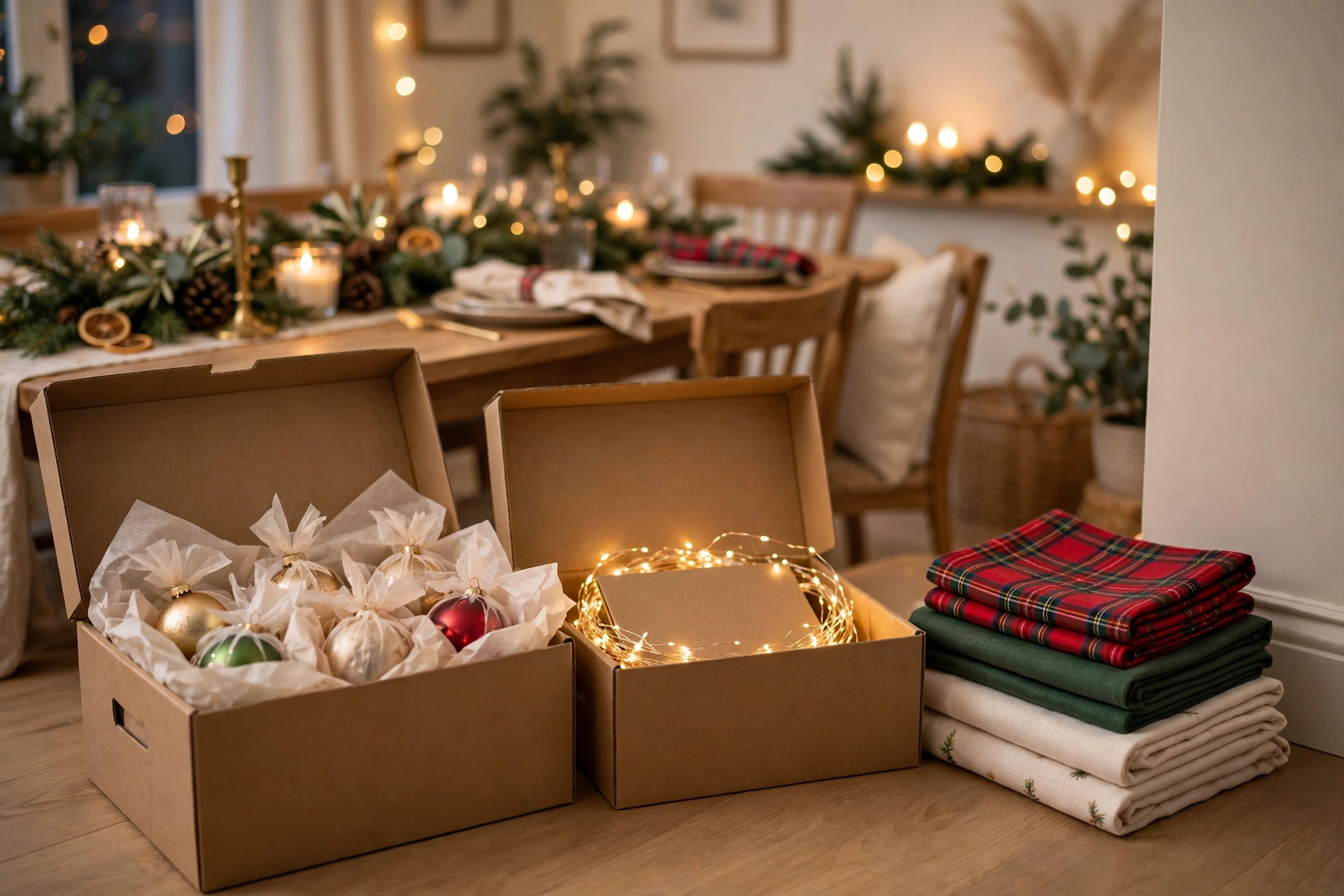
Every Christmas decoration you put up in the dining room has to come down in January, and the pack-away is where most of it gets broken. Plan it now, while you still remember what goes where.
Photograph the finished table and sideboard from two angles before the first dinner, and keep the photos in the decoration box. Wrap ornaments in tissue in the same box they came in, coil fairy lights around a piece of cardboard so they do not tangle, and label every box by room — "Dining room: table" and "Dining room: sideboard" — not just "Christmas". A full dining room packs away in about an hour with a plan, and next December you will open a box and know exactly what you have.
Conclusion
A Christmas dining room doesn’t need a caterer’s budget or a decorator on call. It needs a dressed table, low warm light, and one focal point — a garland, a low centerpiece, a dressed chandelier — that everything else quietly supports.
If you do only three things from this list, make them these — lay a garland down the center of the table, layer the plates with a charger, and dim the overhead light so the candles can work. The dining room is where Christmas dinner actually happens; a little styling there goes a very long way.

Mush Decor
Mush Decor is the founder and editor of The Happy Decor, where he publishes practical, budget-friendly home decor guides — room-by-room ideas with real measurements, materials and styling details. Follow along on Pinterest @thehappydecorofficial.
More about Mush DecorRelated articles
 Christmas Ideas
23 Fresh Greenery Front Door Christmas Ideas
Fresh greenery front door Christmas decor ideas: wreaths, garlands, bows, lights, and styling tips with real materials and measurements.
Read More Christmas Ideas
23 Classy Outdoor Christmas Lights (No Inflatables)
From warm-wreath porch lighting to architectural uplights, here are 23 classy outdoor Christmas light ideas that skip inflatables and stay elegant.
Read More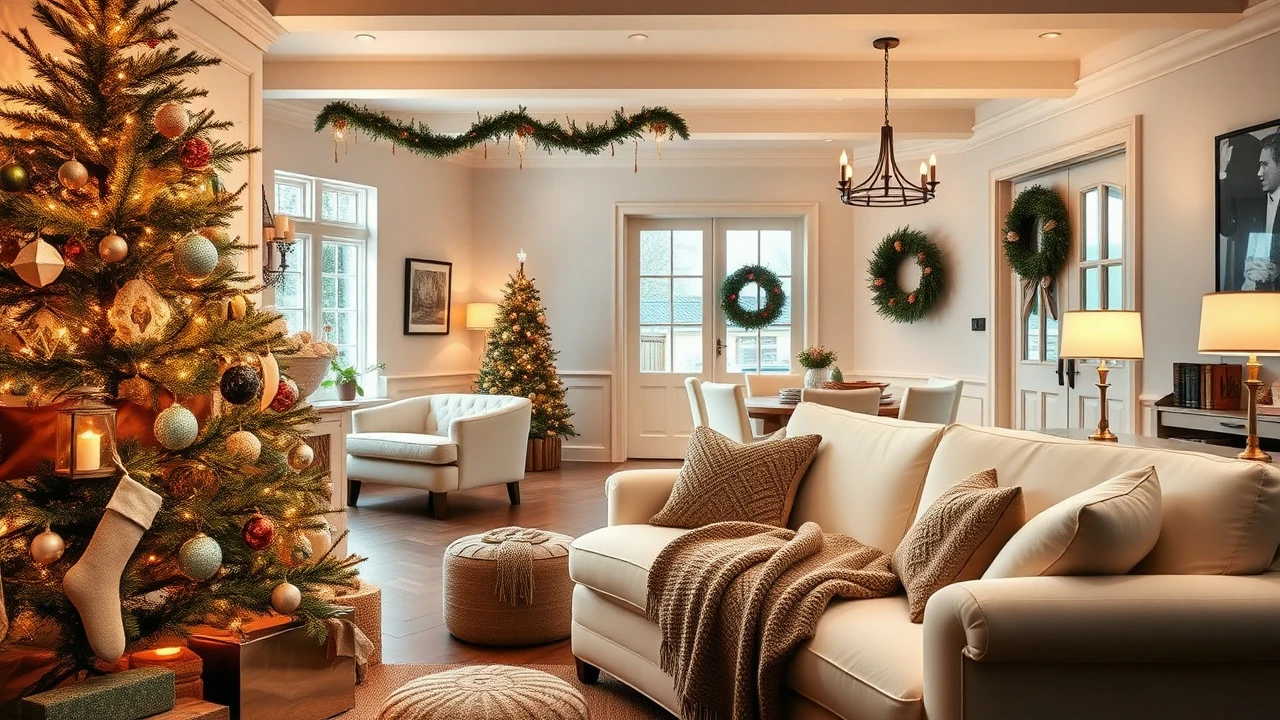 Christmas Ideas
23 Whimsical Christmas Decor Ideas for the Whole House
Get playful Christmas styling across your whole home: whimsical wreaths, garlands, table ideas, mantel details, and lighting tips.
Read More